The Quiet Power Of Women In Their 70s Who Stopped Performing And Started Living

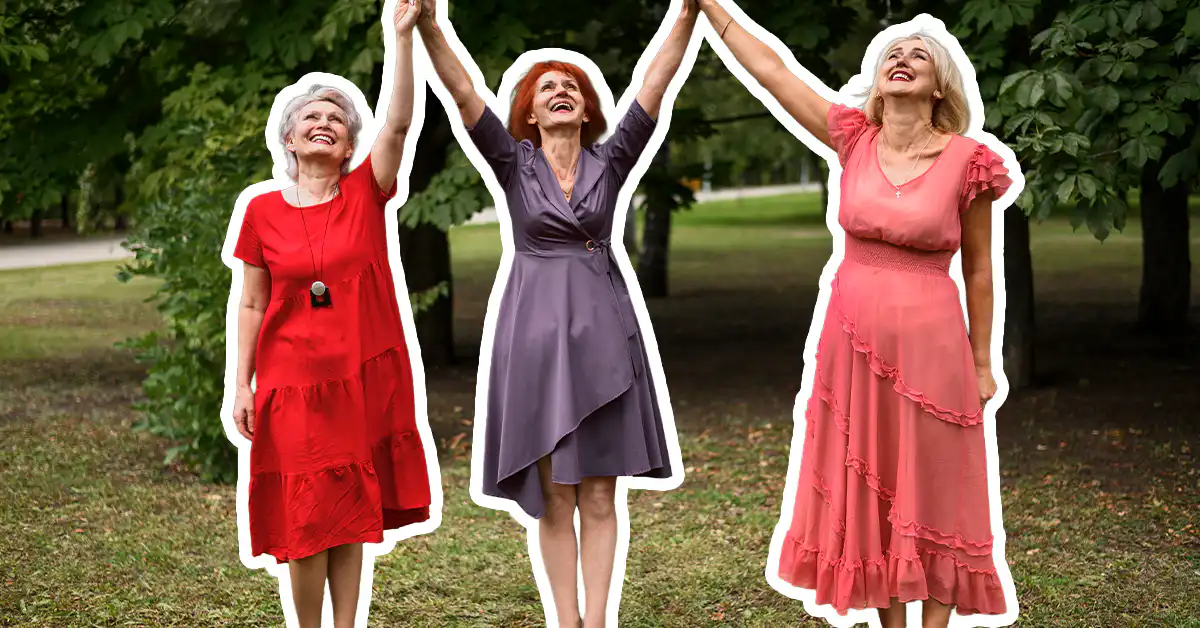
There is a version of older womanhood that the culture has been slow to document accurately: the woman in her 70s who is not diminished, not nostalgic, not waiting for anything. Who woke up somewhere in the previous decade to the realization that the performance had cost more than it returned, put it down, and discovered on the other side of putting it down a quality of living that the performing years had rarely permitted.
This is not the inspirational story of triumph over adversity. It’s quieter than that and, in some ways, more radical: the story of a woman who stopped doing the things she had always done because someone was watching, and found that when the audience dissolved, a much more interesting person was still there. That person had been there the whole time, mostly waiting for permission that was never going to come from outside.
Here’s what that shift looks like from the inside, and what research says about why this particular decade produces it with such regularity.
1. The performance of femininity becomes optional in a way it genuinely wasn’t before
A significant portion of what women do across their lives — in appearance, in behavior, in the ongoing management of how they are perceived and received — is organized around being legible to an evaluative gaze that had its own requirements. By the 70s, for many women, that gaze had either withdrawn or become much easier to be indifferent to. The liberation is real, and it shows up in the most practical ways: the clothing worn because it feels good rather than because it reads correctly, the opinion expressed without the diplomatic softening that used to arrive automatically, the social obligation declined without the elaborate justification that once seemed necessary.
Research on gender, aging, and social visibility shows that while cultural invisibility in older women is a real phenomenon with real costs, it also carries an unexpected benefit: the reduction of evaluative pressure that had shaped behavior for decades. Many women in later life describe this as one of the least-anticipated gifts of aging — the experience of moving through the world in a body that is no longer primarily organized around its legibility to others.
2. Decades of evidence have clarified what actually matters
The woman in her 70s has watched enough play out to have a calibrated sense of which concerns were worth the energy spent on them and which were not. The career slight that consumed months of rumination. The relationship that seemed essential until it ended and turned out not to have been. The opinion of the person whose approval felt critical and who turned out to be, in the longer view, entirely beside the point. The evidence accumulates. The priorities update. The recalibration of what deserves energy is not pessimism. It’s the product of an unusually well-informed cost-benefit analysis.
Research on priority shifting and later-life well-being shows that the movement toward emotionally meaningful investment and away from achievement and status-seeking — which researchers call socioemotional selectivity — accelerates significantly in the 70s and produces measurably higher life satisfaction. The narrowing of focus isn’t giving up. It’s finally spending the available energy where decades of evidence say it actually returns something.
3. Friendships in this decade have a depth that earlier ones rarely did
The friendships that have survived to the 70s have been tested in ways that most early-life friendships weren’t: by grief, by major life change, by the specific intimacy of having watched each other become different people across decades and staying anyway. What remains tends to be the distillation of something genuinely good. And the new friendships formed in this decade, freed from the professional competition and social positioning that complicated earlier ones, often arrive with a directness and warmth that surprises people who expected friendship to become harder to find with age.
Research on friendship quality in later adulthood shows that older adults report higher satisfaction with their close friendships than younger adults do, and that the smaller, more carefully curated networks of later life produce more felt closeness than the larger networks of earlier decades. The quantity declined. The quality improved in a way that more than compensates.
4. Creative and intellectual life frequently accelerates rather than declines
The constraint of earlier decades — the professional requirements, the caregiving years, the sheer logistical weight of maintaining a life with dependents and obligations — had consumed time and attention that are now, in the 70s, substantially freed. The woman who always wanted to write, paint, learn something new, pursue the intellectual direction she never had space for — this decade is often the first one where the space genuinely exists and where the internal self-critic that policed the attempt has quieted enough to let her try.
Research on creative expression in later adulthood documents consistent patterns of creative acceleration in people who reach their 70s with the infrastructure of their earlier lives behind them. The work produced in this decade is often some of the most personally meaningful and formally accomplished of a lifetime — not despite the age at which it arrives, but partly because of it. The long formation finally gets to produce something.
5. Saying “no” becomes a complete sentence
The social infrastructure of explanation, justification, and apology that used to accompany declining an invitation, a request, or an obligation had largely dismantled itself by the 70s. Not through rudeness but through the earned clarity that most of the elaborate justification was never required in the first place and was primarily serving the comfort of whoever was asking rather than any genuine social necessity. The “no” that arrives without a paragraph of context is not cold. It is the behavior of someone who has finished performing deference they didn’t owe.
Research on self-concept and boundary-setting across the lifespan shows that the capacity for direct refusal without extended self-justification increases substantially in later adulthood, correlating with the self-concept stability and reduced social anxiety that accumulate across decades. The woman who finally says no without the paragraph isn’t being difficult. She’s being accurate about what she owes and what she doesn’t.
6. The body becomes a subject of curiosity rather than a project of correction
The decades spent in a complicated relationship with the physical self — its inadequacies, its failures to meet the standard, its ongoing project of being made more acceptable — give way, for many women in their 70s, to something that resembles, if not quite peace, then at minimum a much-reduced hostility. The body has carried them through seven decades. It has its history on it. The energy that once went to correcting it tends to redirect toward something more interesting.
Research on body image and aging in women consistently shows that body satisfaction increases in later life for women across most dimensions — not because the body becomes more conventionally ideal, but because the standards being applied to it become more internally generated and less borrowed from external evaluation. The shift from how it looks to how it feels is the shift. And it tends, once it arrives, to feel like something that should have happened much sooner.
7. The life being lived is finally recognizably theirs
The composite of a life built partly around other people’s requirements, expectations, and needs — which is the life most women have lived for most of their years — tends to yield, in the 70s, to something that has a different quality: chosen, rather than accumulated. The days are organized around what the person actually wants to do with them, in a way that was genuinely not available during the decades when the infrastructure of other people’s lives required constant management. This is not selfishness. It is the natural state of a person whose turn it finally is.
Research on autonomy and life satisfaction in later adulthood shows that perceived autonomy — the sense of living according to one’s own values and choices rather than external demands — is one of the strongest predictors of well-being in later life, and that it tends to be higher in the 70s than in any previous decade. The freedom that was always nominally available turns out to have been structurally constrained in ways that the 70s, for the first time, substantially remove.
The culture has a limited vocabulary for what women in their 70s who are actually flourishing look like. The available frames are either loss — aging as diminishment, the fading of the qualities that mattered, or the remarkable older woman as exception rather than pattern. Neither frame is adequate to the actual experience.
The actual experience, for a significant number of women in this decade, is something quieter and more ordinary than either frame: the experience of a life that finally has room in it for the person who was always supposed to be living it. That person was never absent. She was just very busy, for a very long time, managing everything else.
The 70s, it turns out, are often when she finally gets the place to herself. And what she does with the quiet is frequently the most interesting thing she’s done yet.