6 Simple Signs Of Low Emotional Maturity That Show Up In Everyday Relationships

Emotional maturity isn’t about age. You probably know a sixty-year-old who still throws tantrums when they don’t get their way, and a twenty-five-year-old who handles conflict with the grace of a seasoned diplomat. The number on your driver’s license guarantees nothing about how well you manage your emotions.
What makes low emotional maturity tricky to identify is that it doesn’t always look dramatic. It’s not always screaming matches and slammed doors. More often, it shows up in subtle, everyday patterns—the small ways someone handles disagreement, discomfort, and the normal friction of sharing life with another person.
Emotional intelligence research shows that these patterns predict relationship satisfaction more reliably than almost any other factor. Here’s what to watch for.
1. Every disagreement becomes a fight about the relationship itself
You mention that the dishes weren’t done. Suddenly you’re having a conversation about whether you even appreciate them, whether you’re happy in the relationship, whether you’d be better off with someone else. The original issue—dishes—has been completely abandoned.
Emotionally immature people can’t contain conflict. A small problem feels like an existential threat, so they escalate it to match their internal alarm level. “You forgot to take the trash out” becomes “you don’t respect me” becomes “maybe we should break up.”
Emotional regulation allows mature people to hold a disagreement at its appropriate scale. The dishes are just dishes. The trash is just trash. An emotionally mature partner can discuss a problem without turning it into a referendum on the entire relationship.
2. They go silent instead of communicating
Something is clearly wrong. Their energy has shifted. They’re giving one-word answers, avoiding eye contact, radiating displeasure. But when you ask what’s going on, you get: “Nothing.” “I’m fine.” “Don’t worry about it.”
The silent treatment—or its softer cousin, passive withdrawal—is one of the most common signs of low emotional maturity. It communicates displeasure while refusing to name it, which forces the other person into a guessing game they can’t win.
Stonewalling research identifies this pattern as one of the strongest predictors of relationship failure. The silent partner gets to feel self-righteous while the other person scrambles to fix a problem that hasn’t been articulated. It’s control disguised as suffering.
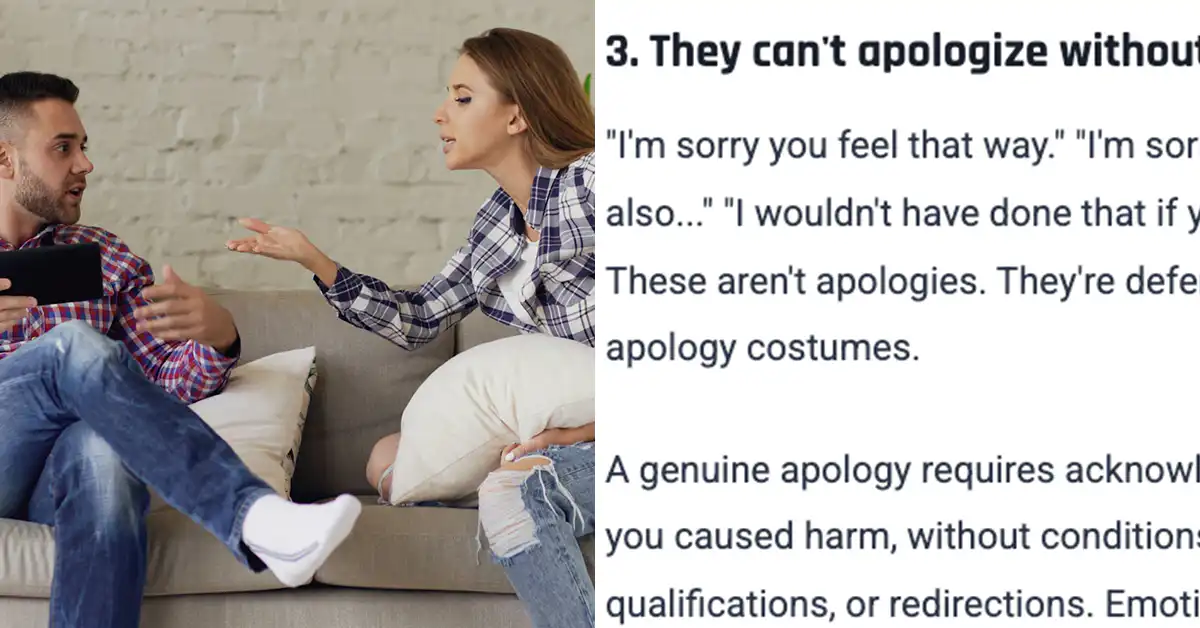
3. They can’t apologize without deflecting
“I’m sorry you feel that way.” “I’m sorry, but you also…” “I wouldn’t have done that if you hadn’t…” These aren’t apologies. They’re defenses wearing apology costumes.
A genuine apology requires acknowledging that you caused harm, without conditions, qualifications, or redirections. Emotionally immature people can’t do this because accepting responsibility feels like accepting that they’re bad. They can’t separate “I did a bad thing” from “I am a bad person.”
This conflation makes authentic apology impossible. Every admission of fault threatens their self-concept, so they protect themselves by distributing blame. You end up apologizing for being hurt by their behavior, which is a neat trick that leaves nothing resolved.
4. Your emotions are always inconvenient for them
You’re sad and they seem annoyed. You’re anxious and they seem impatient. You’re excited about something and they can’t match your energy. Your emotional experience is consistently treated as a disruption to their comfort rather than a normal part of being in a relationship.
Emotionally mature people can hold space for feelings that aren’t their own. They can sit with your sadness without trying to fix it, tolerate your anxiety without dismissing it, and share your excitement without competing with it. Empathy is the ability to be present with someone else’s emotional experience. Low emotional maturity makes this feel threatening or burdensome.
If you’ve started suppressing your feelings to avoid their reaction—if you cry in the bathroom or wait until they’re gone to feel what you feel—that’s a sign that your partner’s emotional immaturity is shrinking your emotional life.
5. They keep score
“I did the laundry last time.” “I always drive.” “I took your mother to lunch three months ago.” Every act of kindness is logged, timestamped, and held in reserve for future deployment during arguments.
Score-keeping transforms a partnership into a transaction. Instead of two people contributing because they care, it becomes a ledger of debts and credits where generosity always has strings attached.
Relationship research shows that happy couples practice what psychologists call “positive sentiment override”—they assume good intentions and don’t track contributions like an accountant. Unhappy couples keep meticulous mental records and deploy them as weapons. If your partner remembers every favor they’ve done and every time you fell short, they’re not being fair. They’re building a case.
6. They make you responsible for their feelings
“You made me angry.” “You ruined my day.” “If you hadn’t done that, I wouldn’t feel this way.” Their emotional state is always someone else’s fault—usually yours.
Emotionally mature adults understand that while others can trigger emotions, the emotions themselves are their own responsibility to manage. Someone can do something frustrating, but how you respond to that frustration is on you.
Emotional ownership is foundational to healthy relationships. Without it, you become a hostage to your partner’s moods—constantly adjusting your behavior to prevent reactions you’ll be blamed for. It’s an exhausting dynamic that gives one person all the power and the other all the responsibility.
Recognizing these patterns matters, whether you’re seeing them in a partner or in yourself. Emotional maturity isn’t fixed at birth—it’s developed through awareness, effort, and often therapy.
If you’re with someone who displays these patterns, the question isn’t whether they can change. People can always grow. The question is whether they want to, and whether they’re willing to do the work. Because without willingness, awareness means nothing.
And if you recognize yourself in any of these signs, that recognition is the beginning. You can’t fix what you can’t see, and the fact that you’re seeing it means you’re already further along than you think. Emotional maturity isn’t about never making mistakes. It’s about being honest when you do, and committed to doing better next time.