9 Painful Signs You’re In Love With Someone Who Doesn’t Even Think Of You

There’s a particular kind of pain that comes from loving someone who barely registers your existence. Not someone who hates you or treats you badly—that would almost be easier, because at least hatred requires attention. This is worse. This is being invisible to someone who occupies every corner of your mind.
You check their social media knowing they’ll never check yours. You replay brief interactions looking for meaning that isn’t there. You build an entire emotional world around someone who couldn’t describe your eye color if asked.
Unrequited love is one of the most common human experiences, and one of the least discussed honestly. We romanticize it in movies and songs, but living inside it is something else entirely. If any of the following feel familiar, you already know.
Related: 7 Behaviors That Make You Seem More Attractive, According to Psychology
1. You know their schedule better than your own
You know when they post on Instagram. You know when they’re usually online. You know their Tuesday meetings run late and their Fridays end early. You’ve built a mental map of their life that they’d find alarming if they knew about it.
Meanwhile, they couldn’t tell you what day your birthday falls on. The information imbalance is staggering, and it reveals the fundamental asymmetry of your situation. You’re studying them like a subject. They haven’t enrolled in your class.
Limerence research describes this obsessive monitoring as a hallmark of unreturned romantic attachment. Your brain is treating this person as a survival-level priority, allocating massive cognitive resources to tracking someone who allocates none to tracking you.
2. You interpret every crumb of attention as a signal
They liked your photo. They responded to your story with a laughing emoji. They said “hey” in passing at work. And your brain immediately builds a cathedral on these tiny foundations. Maybe they’re interested. Maybe this is the beginning. Maybe they’ve been thinking about you too.
They haven’t. What feels like a signal to you was a reflex to them—the social equivalent of holding a door open. They’d have done the same for anyone. But your confirmation bias is so strong that neutral gestures become evidence of hidden feelings.
The crumb interpretation keeps you hooked because it maintains hope. And hope, in this context, is what’s actually hurting you.
3. You’ve rehearsed conversations that will never happen
In the shower, in the car, lying in bed at night—you’ve had entire dialogues with this person. Deep, meaningful exchanges where they finally see you, where the connection clicks, where everything you feel is suddenly mutual.
These imagined conversations feel almost real. They provide a temporary hit of the connection you’re craving. But they’re also a form of maladaptive daydreaming—your mind creating a substitute for something reality isn’t providing.
The rehearsals reveal something painful: you’re building intimacy alone. The relationship that exists in your head has no counterpart in theirs. You’re two people in completely different stories.
4. You change yourself hoping they’ll notice
New haircut. New outfit. New hobby that happens to align with their interests. You’re quietly shapeshifting, becoming someone you think they’d want, hoping that the next version of you will be the one that finally catches their eye.
It won’t. Not because you’re not enough, but because the problem was never about what you look like or what you’re into. The problem is that they’re not looking. You could transform into their exact stated type and it wouldn’t matter, because attraction can’t be manufactured through effort.
The self-modification is also dangerous for a different reason: you’re losing yourself. Every change made for someone who isn’t watching takes you further from who you actually are.
5. Their name makes your heart rate change
Someone mentions them in passing and your body reacts before your mind catches up. Heart rate spikes. Stomach drops. Attention narrows. It’s a physiological response you can’t control, triggered by two syllables that shouldn’t have this power over you.
This is your nervous system treating a person like a threat and a reward simultaneously. Dopamine pathways have been activated, and they don’t distinguish between reciprocated and unreciprocated love. Your brain chemistry is in love even though the relationship doesn’t exist.
The physical response makes the situation feel more real and more justified than it is. Your body is telling you this matters, that this person is important. Your body is wrong—or at least, it’s working with incomplete information.
6. You make excuses for their indifference
They’re busy. They’re going through something. They’re not good at expressing feelings. They probably think about you more than they show. You’ve built an elaborate defense system for their lack of interest, finding explanations that keep hope alive.
Some of these explanations might be partially true. People are busy. Some people are bad at expressing themselves. But the simplest explanation is usually the correct one: if someone wanted to be in contact with you, they would be. Human motivation isn’t that mysterious. We make time for what matters to us.
The excuses serve you, not them. They allow you to stay invested in a fantasy rather than confronting a reality that hurts.
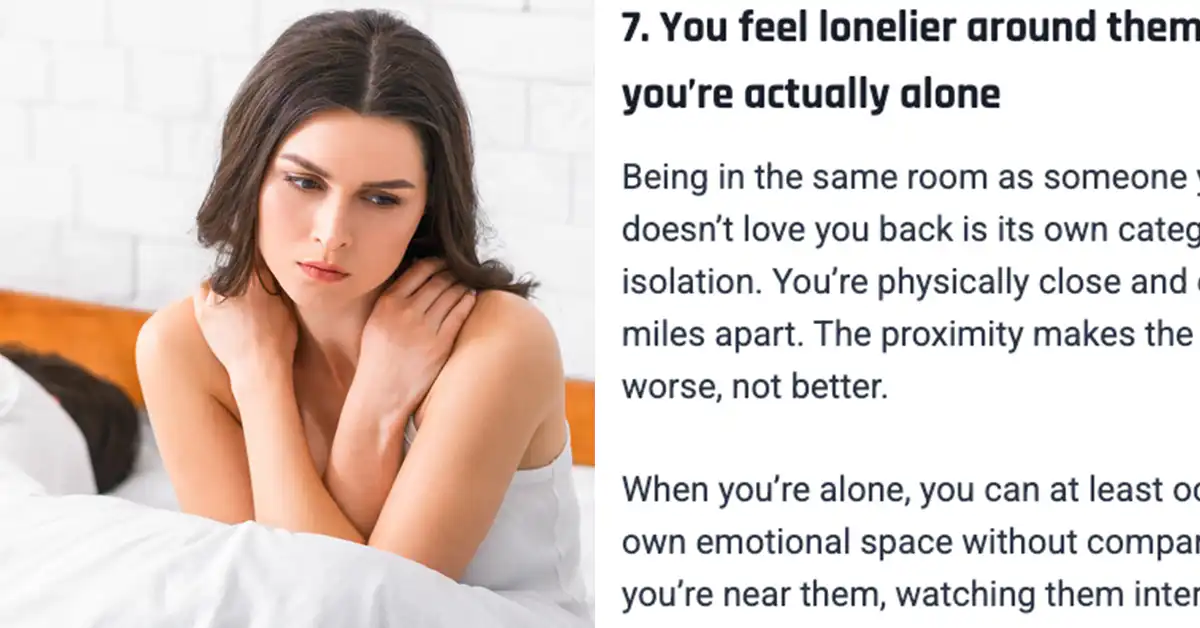
7. You feel lonelier around them than when you’re actually alone
Being in the same room as someone you love who doesn’t love you back is its own category of isolation. You’re physically close and emotionally miles apart. The proximity makes the distance feel worse, not better.
When you’re alone, you can at least occupy your own emotional space without comparison. When you’re near them, watching them interact warmly with others while you get polite neutrality, the gap becomes unbearable.
Research on loneliness shows that feeling alone while surrounded by people is more psychologically damaging than actual solitude. Your situation is a concentrated version of this—alone in the presence of the one person whose attention you want most.
8. You’ve turned down people who actually want you
Someone showed genuine interest. Someone was available, kind, and clearly into you. And you felt… nothing. Or worse, you felt annoyed—because they weren’t the right person, and the right person is someone who doesn’t know you exist.
This is one of the cruelest tricks of unrequited love: it makes available people seem less attractive. The person who wants you can’t compete with the person you’re obsessing over, because obsession creates artificial intensity that healthy interest can’t match.
You’re rejecting real connection in favor of imagined connection. Attachment psychology suggests this pattern often reflects deeper beliefs about what you deserve—that earned love feels more legitimate than freely given love.
9. You know you should let go but the idea feels like dying
Intellectually, you understand the situation. You know they don’t feel the same way. You know you’re wasting emotional energy. You know you’d be happier if you could move on. But the thought of actually releasing this person from your heart feels catastrophic.
That’s because it is a kind of death—the death of a possibility, a fantasy, a future you’d been quietly planning. Grief doesn’t require a relationship to end. It requires a hope to end. And letting go of hope for someone you love is one of the most painful things a person can do.
The inability to let go isn’t weakness. It’s your brain clinging to a dopamine source that’s become deeply wired. Breaking the attachment requires the same neurological rewiring as breaking an addiction, and it’s about as comfortable.
If you’re living inside this right now, I want you to know something: your feelings aren’t pathetic. Loving someone who doesn’t love you back is painful precisely because the love is real—it just doesn’t have anywhere to land.
But real love that goes nowhere is still love going nowhere. The feelings are valid; the situation is not sustainable. At some point, you have to decide whether to keep pouring into an empty vessel or redirect that capacity toward someone who can actually receive it.
You deserve to be thought about. Not obsessively, not anxiously—just regularly, warmly, by someone who’s glad you exist. That person is out there, but you’ll never find them while your heart is occupied by someone who doesn’t even know it’s theirs.
Letting go won’t feel like freedom at first. It’ll feel like loss. But it’s loss of something you never actually had—and that’s a different kind of grief. One you can survive. One you will survive.